
Arrest History in Sebastian County
Arrests can originate with the Sebastian County Sheriff, Fort Smith Police Department, Greenwood Police Department, Barling Police, Arkansas State Police, or another agency with local authority. The arresting agency creates its report. If the person enters county jail custody, the Sebastian County Adult Detention Center creates a booking record. Filed charges then produce a separate court file, and reportable events may reach the Arkansas state repository.
An arrest history is therefore not one document held in one place. It may combine agency reports, multiple bookings, court dockets, and state-reported cycles over time. The official research does not establish a single online retention period for every arrest. Current inmate inquiry is strongest for current or recent custody, while older matters may require an agency request, court search, or Arkansas State Police criminal-history channel.
Searching the Inmate Inquiry
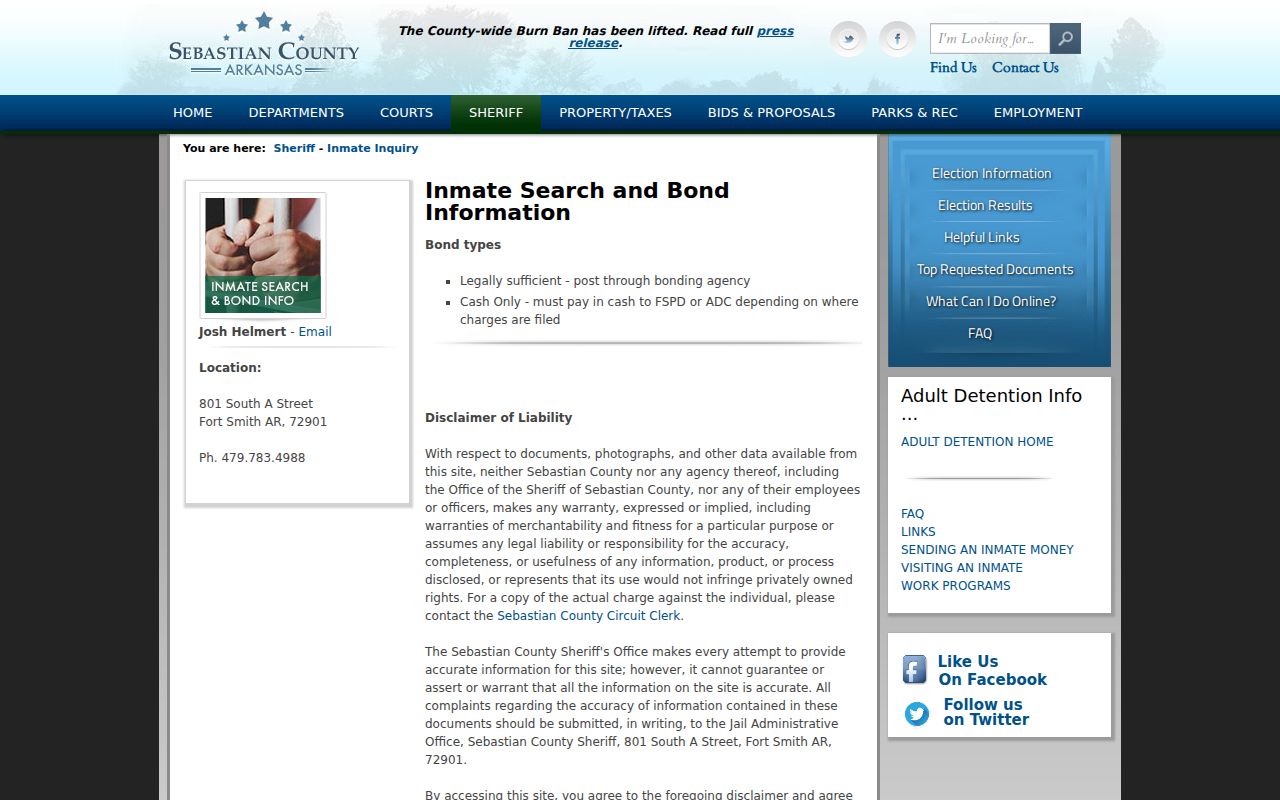
The sheriff's Inmate Inquiry is the most direct online route for a recent Sebastian County booking. A public user must accept the disclaimer before searching. The county documents searches by last name, first name, global subject number, booking number, and booked-in date range. A number is the most precise identifier; names and date ranges help when it is not known.
| Search Field | Required | Use |
|---|---|---|
| Last Name | Optional | Broad name search for a current or recent booking. |
| First Name | Optional | Narrows common surnames when combined with last name. |
| Global Subject Number | Optional | Connects records associated with the county subject identifier. |
| Booking Number | Optional | Targets one specific booking event. |
| Date Range Booked In | Optional | Limits results to an expected intake period. |
| Agree | Required | Accepts the public-information disclaimer before access. |
How to Look Up Sebastian County Arrests
The best channel depends on the question. Inmate inquiry answers whether someone appears in county booking data. The arresting agency holds its report, the clerk holds filed charges and outcomes, and Arkansas State Police provides statewide criminal-history products. Use identifiers from one record to locate the next rather than treating one portal as complete.
- Search Inmate Inquiry using a name, booking number, subject number, or booking-date range for recent county custody.
- Request the arrest or incident report from the arresting agency, using sheriff records or the appropriate city police channel.
- Match filed charges to Search ARCourts, older iSeries records, or the relevant Greenwood, Barling, or Fort Smith district court.
- Use the Arkansas State Police Identification Bureau process for a statewide repository record.
- Submit an Arkansas FOIA request through county NextRequest when county-held public records are not available through a direct portal.
City Arrests Follow Different Paths
A Fort Smith arrest report starts with the Fort Smith Police Department, which links a records-request route, a Citizen Services Portal, online reports, and a separate accident-report service. Its nonemergency number is 479-709-5000. County inmate inquiry can show jail custody, but it does not replace the FSPD narrative report.
Begin with Greenwood Police for the agency report. Filed district matters can be checked through Greenwood District Court at 301 E. Center.
Use Barling city police channels for the report and Barling District Court for local criminal or traffic court records.
Use Sheriff Records, Civil Special Services, inmate and warrant portals, or county NextRequest for county-held public records.
All county inmates are housed at the Adult Detention Center, so an arrest by city police may still produce a county jail entry. That shared jail does not merge the underlying agency records. Ask the agency that created the report for its copy and the court that received the charge for the case outcome.
What an Arrest Record Shows
The official inmate-result inventory includes custody status, demographics, physical descriptors, aliases, city and state of address, multiple bookings, release date, bond, and charges. The jail separately identifies court dates, bond amount, and scheduled release date as public inmate information. These fields describe a booking and current record status, not the final truth of the accusation.
| Booking Number | Identifies a particular jail intake and supports a precise inquiry. |
|---|---|
| Booking Date & Time | Places the intake in sequence and helps distinguish multiple bookings. |
| Arresting Agency | Identifies the office to contact for the arrest or incident report. |
| Charges | Lists booking allegations; obtain actual charge copies from the correct clerk. |
| Bond | Shows amount and may distinguish legally sufficient from cash-only bond. |
| Mugshot Policy | The official county system may show a booking image when available; no private images are reproduced here. |
| Release Status | Shows custody or release information, including a release date when recorded. |
Cash-Only and Agency Bonds
The inmate inquiry distinguishes two bond types. A legally sufficient bond is posted through a bonding agency. A cash-only bond must be paid in cash to either the Fort Smith Police Department or the Adult Detention Center, depending on where the charges were filed. That detail matters because arriving at the wrong counter can delay resolution.
- Confirm the booking and bond type through current inmate information.
- Identify whether the charge was filed through FSPD or the Adult Detention Center channel.
- Call 479-783-4988 and follow the instructions to speak with an Adult Detention Center deputy when custody details need confirmation.
- Verify court requirements with the issuing court, especially when a warrant or court order is involved.
Note: Bond information can change with a court order, so confirm the current amount and payment location before taking action.
Recent Arrests and Booking Logs
Sebastian County presents booking information through Inmate Inquiry rather than a narrative arrest blotter. Searchers can use names, county identifiers, or a booked-in date range, then review multiple bookings and current custody details. The Adult Detention Center says public inmate information includes incarceration status, court dates, bond amount, and scheduled release date.
The sheriff does not warrant the accuracy of online data. A person absent from current results may have been released, booked elsewhere, recorded under a variation, or never placed in Sebastian County jail. Recent booking data also does not supply the complete agency report. Written accuracy complaints go to the Jail Administrative Office at 801 South A Street, Fort Smith.
Why the Jail Has 356 Beds
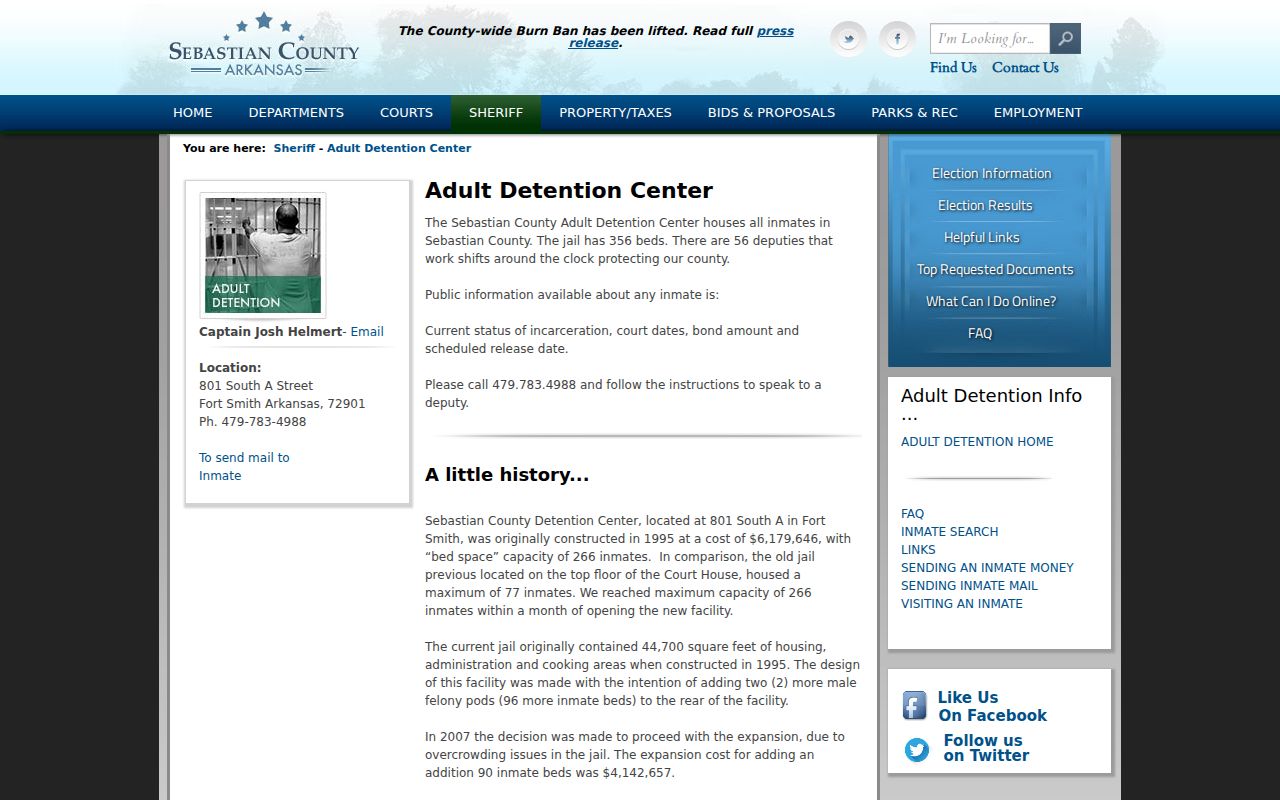
The Adult Detention Center at 801 South A Street has 356 beds and 56 deputies working around the clock. It opened in 1995 with capacity for 266 inmates, replacing an older courthouse-top jail that held no more than 77. The new facility reached its original capacity within a month, making booking capacity a longstanding local concern rather than an abstract statistic.
A 2007 expansion added 90 beds at a cost of $4,142,657. The modern center's role as the shared county jail explains why arrests from different local agencies may converge in one inquiry even though their reports remain distributed. Jail staff can confirm public custody information, but the Circuit Clerk or district clerk is still responsible for actual charges filed in court.
Arrests vs Convictions
An arrest record establishes that an agency documented an arrest or jail admission. It does not establish guilt. A conviction exists only when a court enters a guilty outcome. The agency and jail preserve arrest-side records, the clerk preserves the court case, and the state repository depends on reporting from agencies and courts. Reporting delays can leave local and statewide results out of sync.
| Arrest Record | Conviction Record |
|---|---|
| Created by the arresting agency and jail. | Created through a court's judgment and docket. |
| Shows an arrest or booking event occurred. | Shows the court entered a finding of guilt. |
| Lives with the agency, sheriff, or booking system. | Lives with the clerk and may be reported to the state repository. |
| May be followed by release, no filing, dismissal, or acquittal. | May be followed by sentence, appeal, completion, or eligible sealing. |
Note: An arrest is not proof of guilt; verify every booking against the filed court case and its final disposition.
When a Booking Outlasts the Case
A dismissal or acquittal can end a court case without automatically erasing the separate booking trail. First compare the inmate entry with Search ARCourts or the correct district court. Then obtain the final disposition from the clerk. If the record is eligible for sealing, Arkansas procedure requires filing in the circuit or district court in the county where the offense and conviction occurred.
After a judge approves and the clerk files an Order to Seal, the clerk forwards it to ACIC. Arkansas allows ACIC up to 30 days from receipt to complete its update. Agency and court systems should be rechecked afterward if a sealed item remains visible. Juvenile and already sealed records are not ordinary public lookup material and should not be pursued through general public search routes.