
Criminal Cases in Sebastian County Courts
Felony matters are heard in Sebastian County Circuit Court, part of Arkansas's Twelfth Judicial District. Seven Circuit Court divisions are listed by the county. District courts handle traffic, ordinance, municipal, and lower-level criminal matters. That division of work means a single name may produce records in more than one court, especially when separate incidents or charges fall within different jurisdictions.
The Circuit Clerk is custodian of the circuit case file and provides official copies. Greenwood, Barling, and Fort Smith district courts maintain their own district-level dockets. Greenwood District Court covers criminal and traffic matters in its division. Barling District Court maintains Barling records while excluding Fort Smith, Greenwood, and Central City. Start with the court that handled the case, not merely the city where the person lives.
Search ARCourts and Circuit Clerk Access
Search ARCourts is the statewide public starting point for Sebastian County Circuit Court cases. It replaced Public CourtConnect and displays public information from participating courts using the Contexte system. The Circuit Clerk inquiry page also directs readers to this service and advises partial-name searches when a party may have used an alias.
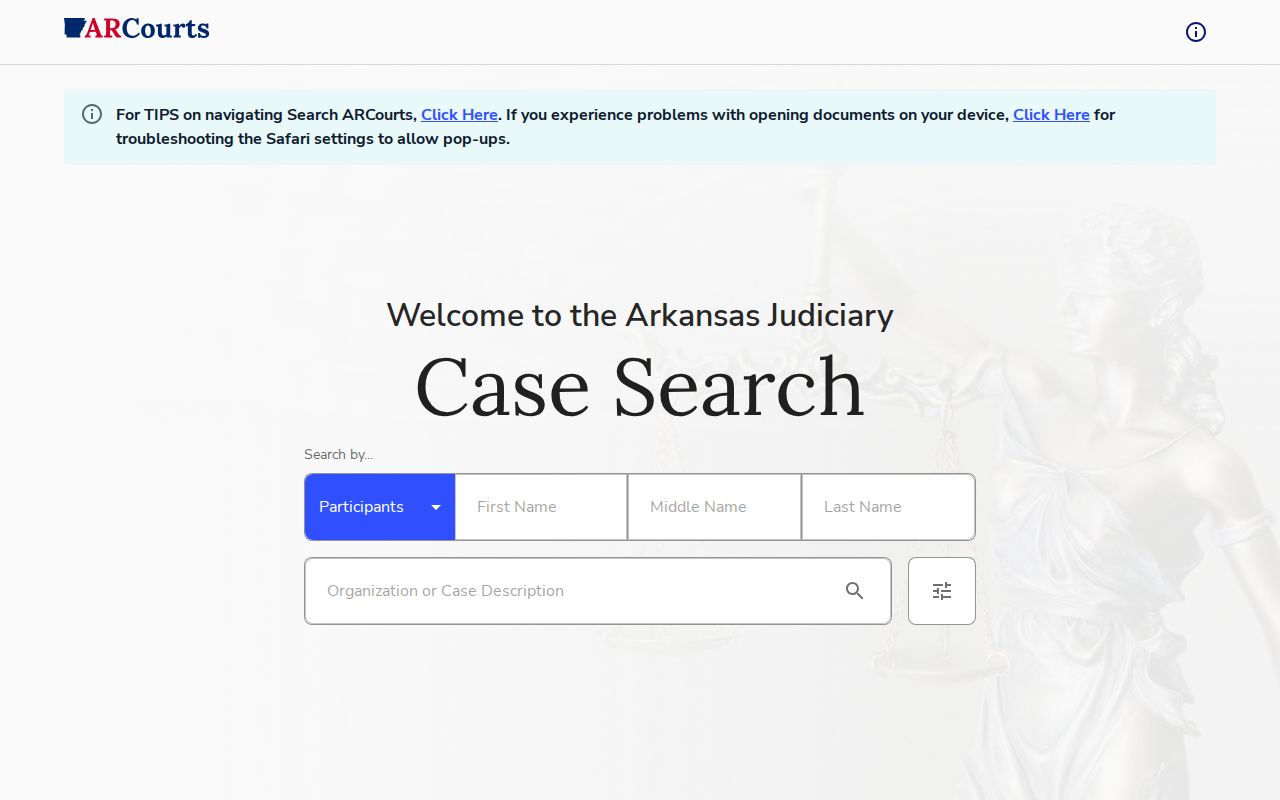
Public-access kiosks are available in both Fort Smith and Greenwood, reflecting Sebastian County's two-district structure. Online information is useful for identifying a case and following docket activity, but the clerk remains the source for an official or certified copy. Copy and certification fees for criminal files were not located in the official material, so confirm the current amount before ordering.
How to Search Case Records
A current circuit search normally begins in Search ARCourts by participant name or case number. Partial names help find aliases or spelling variations. The court and filing period then determine whether Search ARCourts, the older county system, document imaging, or a district-court inquiry is the right next channel.
- Open Search ARCourts and choose the appropriate Sebastian County court or statewide participant search.
- Enter the participant name or exact case number, using a partial surname when aliases or spelling differences are possible.
- Compare the court, filing date, and case type so similarly named people are not confused.
- Read charges, filings, dispositions, future events, judgments, and available document links in context.
- Request the actual charge or an official copy from the Circuit Clerk or the district-court clerk that holds the file.
| Field Label | Type | Required | Notes |
|---|---|---|---|
| Party Name | Text | No | Use full or partial names; partial searches can expose aliases. |
| Case Number | Text | No | Best identifier when copied exactly from a notice or prior record. |
| Court | Select | No | Narrow to Sebastian County Circuit or the relevant district court. |
| Case Type | Select | No | Use criminal criteria to reduce unrelated civil results. |
| Date Range | Date | No | Use the likely filing period, then check the older system when appropriate. |
Pre-2015 Cases Use iSeries
Sebastian County preserves a separate route for Circuit Court cases filed before June 2015. The Circuit Clerk supplies public credentials for the county's iSeries/AS400 system and instructs users to end the session properly. A missing older case in Search ARCourts is therefore not proof that no case exists. Check the filing date and move to iSeries when the matter predates the transition.
The county's Court Documents imaging service is another layer. Its indexing is case-sensitive and uses uppercase criteria. Wildcards can broaden a search, such as CV-2010* for the documented civil example. Criminal document images require the corresponding criminal index class and exact county formatting. If a docket is visible but an image is absent, ask the clerk whether the document is public and available another way.
What the Case File Shows
A case file records what happened after a charge reached court. Search ARCourts may show the parties, judge, filings, charges and dispositions, future events, judgments, and links to some public documents. The docket provides a chronology, while the charging document and judgment answer different questions. Read those components together before drawing a conclusion from a single entry.
| Case Number & Court | Identifies the exact file, jurisdiction, and clerk responsible for official copies. |
|---|---|
| Charging Document | States the allegations filed by the prosecutor; it does not itself prove guilt. |
| Docket Entries | Chronological filings, orders, appearances, and other recorded case activity. |
| Hearing Dates | Past proceedings and future events, subject to later scheduling changes. |
| Disposition & Judgment | Shows how each charge ended and whether the court entered a judgment. |
| Sentence & Conditions | Records punishment and court-ordered terms when a conviction results. |
Greenwood and Barling Record Paths
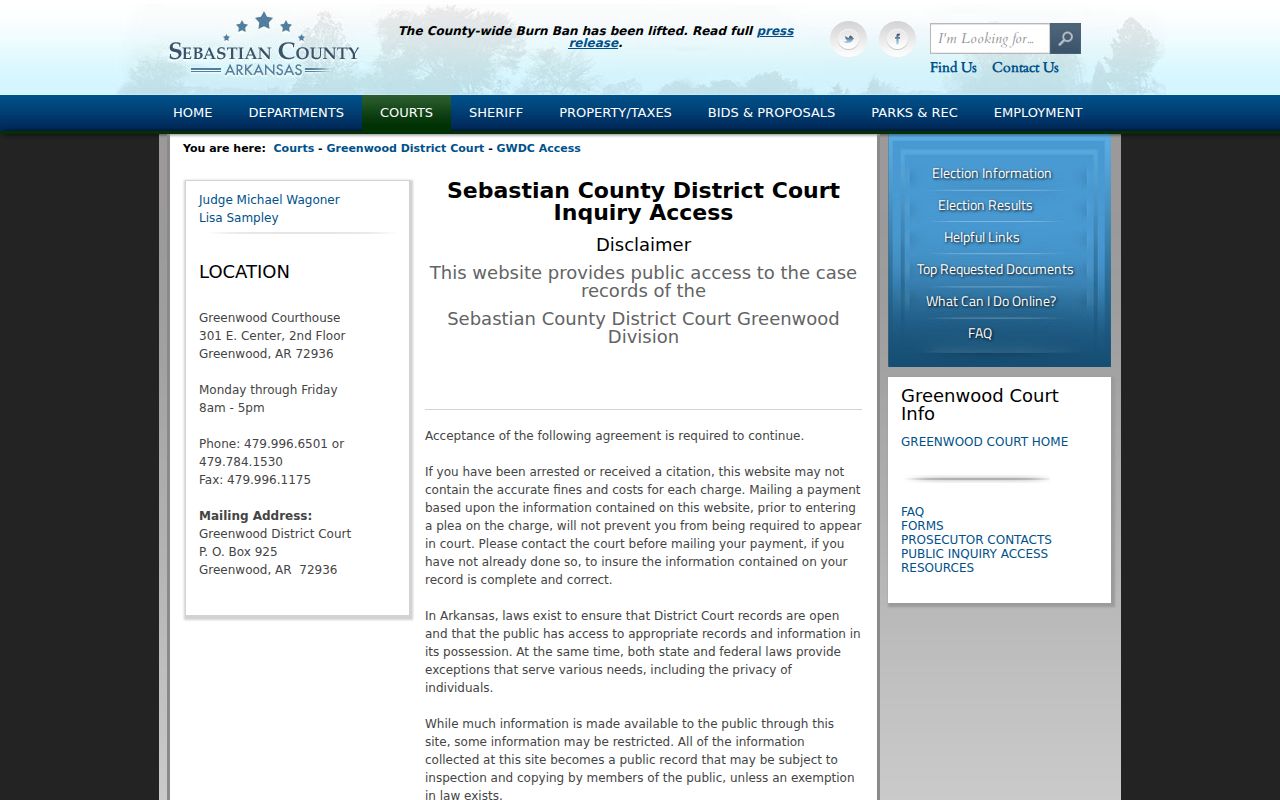
Greenwood District Court offers a public inquiry after the user accepts its disclaimer. Its database includes some criminal and traffic charges from 1984 through 1986 and all such charges from 1986 forward. The court is at 301 E. Center, second floor, Greenwood, and can be reached at 479-996-6501 or 479-784-1530. It also assists with warrants, driver-license issues, and court orders.
Barling District Court handles criminal, traffic, and municipal functions at 307 Fort Street. Its records exclude Fort Smith, Greenwood, and Central City. The clerk is available at 479-242-5978. Fort Smith District Court handles its own district matters and municipal fines at 479-784-2420. These local boundaries explain why a statewide or Circuit Court search alone can miss a district-level record.
Stages of a Criminal Case
A local arrest may lead to booking, but a court case begins only after charges are filed. The docket then records appearances, motions, hearings, pleas or trial activity, and the eventual disposition. Some matters end without conviction; others proceed to judgment and sentencing. The research does not establish standard timing for each stage, so scheduled dates and current docket entries should be verified with the court.
Case flow: Arrest › Booking › Charges › Arraignment › Disposition › Sentencing
Actual Charges Come From the Clerk
The sheriff's inmate and warrant disclaimers direct readers to the Circuit Clerk for a copy of the actual charge. That distinction prevents a common Sebastian County records mistake: treating the short charge label in a jail result as the complete charging document. A booking label reflects intake information, while the filed information or complaint states what prosecutors formally placed before the court.
For a circuit matter, contact the Circuit Clerk at 479-782-1046 and provide the case number, party name, and approximate filing date. For Greenwood, Barling, or Fort Smith district matters, use that court's clerk. Ask whether the document is public, what format is available, and what current copy or certification charge applies. The official research did not locate a published criminal-copy fee, so no amount should be assumed.
A One-County Judicial District
The Twelfth Judicial District consists only of Sebastian County, divided between the upper township or Fort Smith District and the lower township or Greenwood District. The Prosecuting Attorney's offices mirror that structure. The Fort Smith office is in the Courts Building at 901 South B Street, while the Greenwood office is in the courthouse at 301 E. Center. The prosecutor describes the office as one of Arkansas's busiest.
The prosecutor files and pursues criminal charges, but the clerk preserves the court record. Questions about victim-witness services or restitution belong with the Prosecuting Attorney, while copy requests belong with the clerk. The Public Defender at 40 South 4th Street represents eligible people who cannot afford private counsel and may sometimes assist before charges are filed. Neither office replaces a case-record search.
Access & Restrictions
Arkansas court records are generally accessible, but Administrative Order 19 limits public display of protected information. Search ARCourts can omit or redact confidential fields and documents. Juvenile records, sealed matters, and sensitive victim information do not belong in an ordinary public name search. A document link also appears only for some public records, so the online index is not a complete reproduction of every clerk file.
When a known case does not appear, confirm the spelling, aliases, court, and filing era before contacting the appropriate clerk. A filed Order to Seal changes normal public access after the clerk forwards it to ACIC; ACIC may take up to 30 days from receipt to update. The Arkansas Freedom of Information Act does not override court confidentiality rules or turn sealed material into a public record.
Note: Online jail and warrant pages are informational; the Circuit Clerk or district clerk supplies the actual charge and official court copy.